
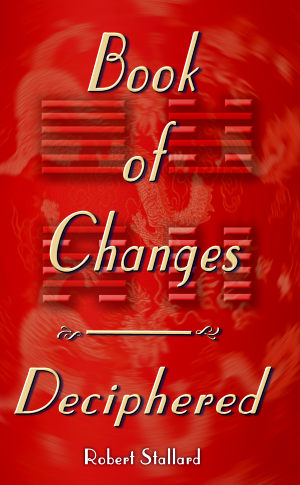
In this book Robert Stallard, author of the popular China information web site chinasage.info ➚, surveys the origin and influence of the 易经 Yi Jing ➚ (or I Ching), arguably the most important book ever written. He documents its immense influence on both Chinese and Western thinking.
The Yi Jing, at least, 3,000 years old has at its heart an ancient mystery that has never been explained. The author looks at the many possible answers to the puzzle and describes a brand-new solution.
The book includes a new translation of the 64 hexagrams of the Yi Jing.
“A fascinating journey of exploration of an ancient Chinese mystery.”
“A remarkable new discovery.”
“Extraordinary, fresh insights into one of the world’s oldest books.”
The first extract is from a passage introducing the Yi Jing and underlining its importance.
This book tackles one of the great unsolved ancient mysteries which lies at the heart of the number one ancient Chinese classic, the ‘Book of Changes’. After setting out the history and the worldwide influence of the book, the quest for a solution to the puzzle is described.
The ‘Book of Changes’ is unlike other books; it has been consulted more often than any other - including the Bible. Although not a holy book it is treated with great reverence by a billion people of all religions. It is not a history book but has had a great influence on Chinese history. It tells no story and lays down no rules. 1 Simple descriptions fail because there is nothing quite like it. Nowadays it is seen as an ancient and complex manual for fortune telling but not so long ago it was the book that guided all the key decisions. For thousands of years it was considered to have the answer to everything. Probably the book’s greatest legacy is its role in the development of binary arithmetic and from that all computers. As China was the leading nation for much of this period, it is hard to over-emphasize the importance of the book. If it provided answers for such a long time with such apparent success, then it must surely contain some wisdom that we can learn from today?
What little is known for certain is that the book is very old, around 3,000 years old. It has a legitimate claim to be the oldest book in the world still in widespread use; the oldest parts of the Bible were written slightly later. It is not even the most ancient Chinese classic, that honour falls to the ‘Book of Songs’.
The second extract concerns how the Yi Jing came to have an important influence on western philosophy, mathematics and science when it became known about there in the 17th and 18th centuries.
Gottfried Leibniz (1646 - 1716) was the most prominent and influential of the first European friends of China. He was a great thinker in many fields of science and philosophy; he was an advocate of bridge-building between nations and cultures. As early as 1666 he began his study of Chinese philosophy which became a life-long passion. 148 He was obsessed with all things Chinese and used the term ‘China’ in his writings more often than any of the other name. He came to know more about the country than anyone else who had not actually visited the country. Leibniz is perhaps best known today by way of Voltaire’s satire ‘Candide’ because there he is portrayed as the foolishly optimistic character Pangloss. It is Pangloss who says “we live in the best of all possible worlds” which reflects Leibniz’s extremely positive take on life.
Leibniz wrote very few books, instead he chose to write long letters to influential figures throughout Europe. In the English-speaking world we are conditioned to idolize Sir Isaac Newton (1643 - 1727) above him. The two came into dispute over who first invented the mathematical calculus. It now seems that they discovered it independently, but it was Leibniz who published first. Newton was paranoid and petulant, obsessed with people stealing his discoveries while Leibniz corresponded with a great many people, freely sharing his ideas. If you consider all that is known about the two rivals, it is Leibniz that you would want to meet not Newton. 150 151 He was the bridge to China in the sense that he pored over all the new information making its way back from the Jesuit mission. 149 In 1689 he spent six months at the Vatican Library which housed all the knowledge garnered from China.
The third extract is part of the section describing the mystery of the Book of Changes ordering that this book attempts to solve.
These chapters are set out in an extremely puzzling order. The oldest and most widely used ordering is the 周易卦序 Zhōu yì guà xù ‘Zhou dynasty change hexagram sequence’ named after the dynasty when it came into use (1100 - 221BCE). Traditionally this sequence is attributed to King Wen (c.1130-1056 BCE) and so is also known as the 文王 Wén wáng ‘King Wen’ ordering. Another less frequently used name is the 后天 Hòu tiān literally ‘After Heaven’ sequence.
What was the motivation behind the author of this ordering? Surely the author would have wanted to frame the complexity of the world within an obscure pattern while maintaining a logical progression? Was it to expose obscure philosophical truths, show harmonious patterns or is it an arbitrary choice?
I set out to discover the hidden rationale behind the ordering. The sequence starts ever so logically with the first hexagram as all ‘solid/yang’ ䷀ and the second as all ‘broken/yin’ ䷁ but thereafter the ordering seems arbitrary. This has led many researchers to claim that it is ‘random’ or that the original logical order became scrambled a very long time ago - either deliberately or accidentally.
The fourth extract lays out the first steps in devising a new solution to this ancient puzzle.
At first sight they have nothing in common with the four (1, 2, 63 and 64) already placed. They do not seem a logical choice and this contributes to the belief that there is no rational explanation for the sequence and yet there is a link and it has been known about for thousands of years. The Yi Jing is loosely translated as the ‘Book of Changes’ for a good reason, much of the commentary on the hexes is concerned with what is the meaning when one line in the hex changes from yin to yang or yang to yin. Now if you look at hex 3 it is one line change from hex 63 with line number 3 yang changing to yin. Similarly hex 4 is one line change from hex 64 with line 4 also changing from yang to yin.
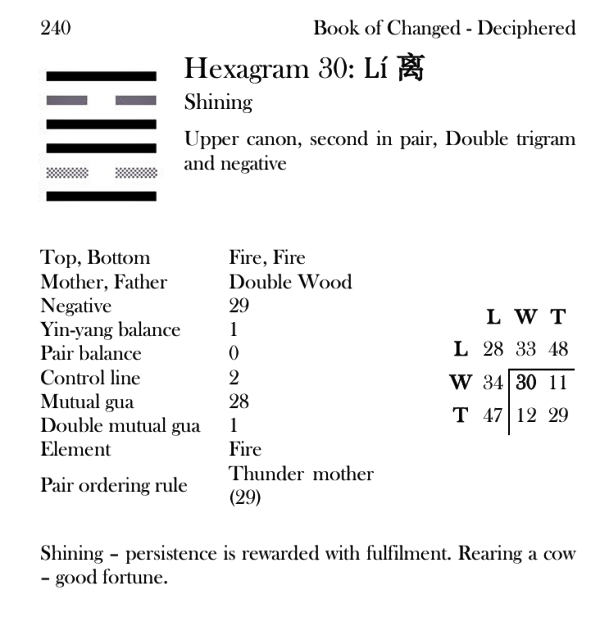
The last extract shows part of hexagram 30's reference information which includes a brand new translation.
 Buy your copy now from Amazon or your local bookstore.
Please feel free to contact me for any query or further information about the book
Also available by the same author : a short introductory book ‘Cracking China ➚’ all about China's history, traditions and culture.

Copyright © 2024-26 Silurian Software (silurian.com)